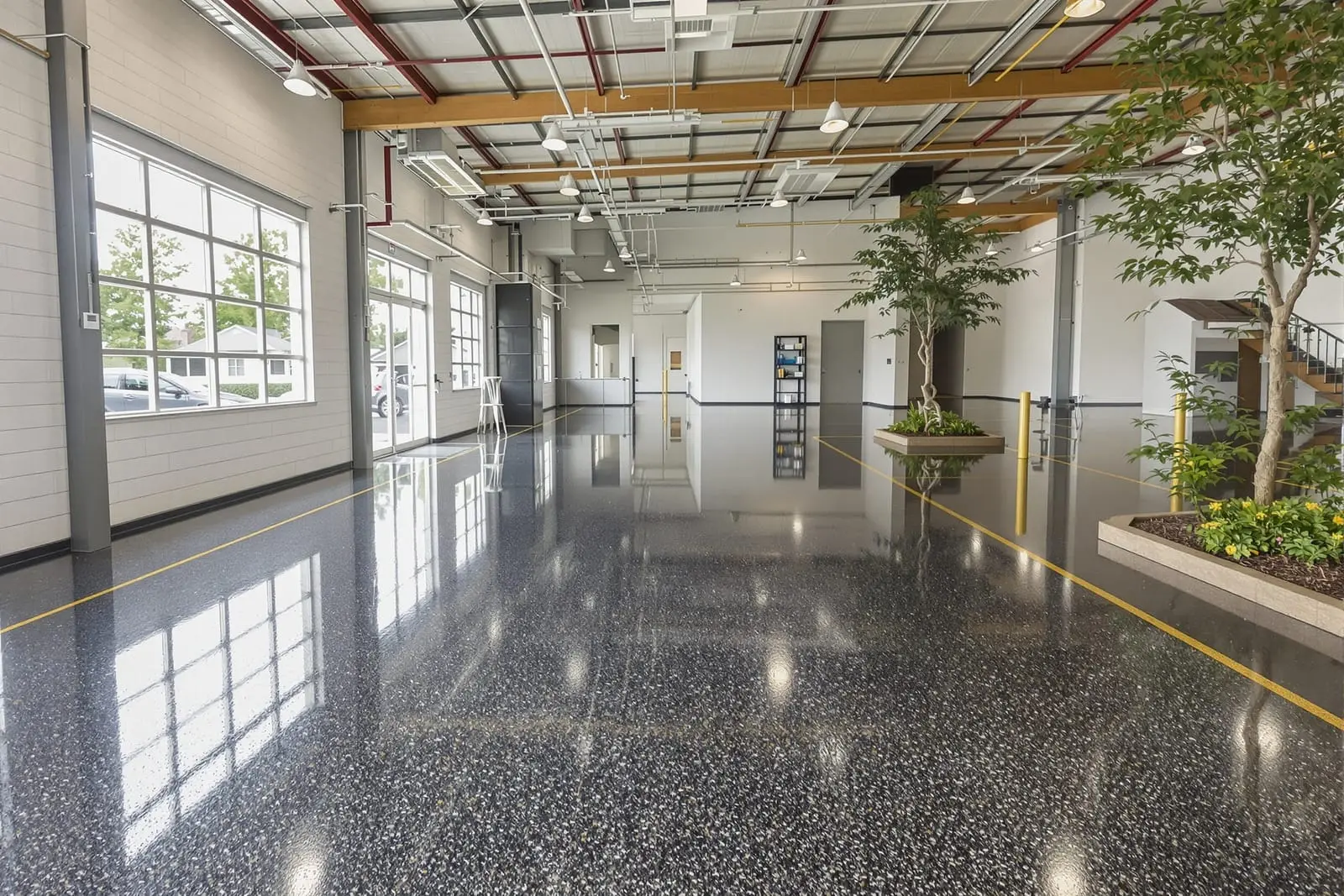
Equip your facility with heavy duty industrial concrete floors in Phoenix, AZ. We pour thick, reinforced slabs that support forklifts, racks, and machinery. Our crews achieve flatness and levelness suitable for warehouse operations. Request a bid for new construction or industrial floor replacement.
Vanguard Concrete Phoenix provides professional industrial concrete floors throughout Phoenix, AZ and the surrounding area. Our licensed, insured crew delivers safe, clean, on-time work with a free estimate before anything begins. Call (602) 560-6905 or request your free quote.
Durable industrial concrete floors built for Phoenix warehouses
Warehouse traffic in Phoenix is tough on concrete. Forklifts, pallet jacks, hot tires from delivery trucks, and blowing desert dust all work against your floor every day. Vanguard Concrete Phoenix designs and installs industrial concrete floors that hold up to that abuse, stay level, and are practical to maintain in a dry, dusty, high heat environment.
For local warehouse owners and facility managers, that means floors that resist slab curling in our hot, low humidity climate, do not pop joints under heavy rack loads, and can be cleaned quickly so operations are not interrupted. We start every project with a site visit to measure existing slab conditions, check soil conditions at dock doors and exterior bays, and review your traffic patterns and racking layout so the floor design matches the way your warehouse actually runs.
Whether you are building a new distribution center off I-10 or upgrading an older warehouse near Sky Harbor, we take into account your operational needs, not just square footage. That includes aisle widths, forklift wheel types, planned automation, and whether you need defined-traffic floors for very narrow aisle systems. Our goal is to give you an industrial concrete floor that supports your business for years with minimal surprise repairs.
How we design industrial concrete floors for heavy loads
The most important part of a durable industrial concrete floor is the design that happens before any concrete is poured. At Vanguard Concrete Phoenix, we start by calculating loads from pallet racks, point loads from uprights, and repetitive traffic from your equipment. We confirm what is under the slab, such as compacted fill, native soil, or existing concrete, because Phoenix sites often include imported fill material that behaves differently under moisture changes.
Based on those findings, we specify slab thickness, typically 5 to 8 inches for warehouses, and choose the right reinforcement. Options include conventional rebar mats, welded wire reinforcement, or steel fibers mixed into the concrete for better crack control under high traffic. Phoenix industrial projects often benefit from fiber reinforcement to minimize sawcut joints that can spall under hard plastic or steel wheels.
We also look closely at joint layout. Joint spacing, load transfer dowels, and armored joint systems are selected based on your traffic paths. For example, if you have order pickers running the same path all day, we try to avoid placing slab joints directly in those wheel paths. For very narrow aisle or high-bay storage, we can discuss higher flatness and levelness tolerances so your equipment sensors and guidance systems work reliably.
This design phase is where we can also coordinate with you on future expansion plans. If you expect to add more racking or heavier equipment within a few years, we can design your industrial concrete floors to handle those loads now, which is usually more economical than reinforcing or tearing out slab sections later.
Our installation process for warehouse and industrial concrete floors
On installation day, keeping your operation and neighbors in mind is a priority. Vanguard Concrete Phoenix plans pours early in the morning when temperatures are lower and wind is calmer. This improves finishing quality and reduces plastic shrinkage cracking, which is a real risk in Phoenix heat if work is done in the middle of the day.
We start by preparing and grading the base. That includes compacting subgrade to the specified density, placing and compacting base rock if needed, and confirming elevations to maintain drainage toward dock areas or floor drains if present. In many Phoenix warehouses we also recommend a vapor retarder below the slab when moisture-sensitive finishes, packaging, or electronics will be stored.
Formwork is set to match floor elevations, including any thickened slab areas at dock levelers, column lines, or machine bases. Reinforcement is installed or fibers are added at the batch plant. We verify concrete mix design at delivery, paying attention to slump, air content if specified, and temperature. High heat days may require retarding admixtures to slow set times so we can properly place and finish.
Concrete is placed using laser-guided screeds when flatter floors are required, then bull floated and power troweled. For industrial concrete floors, we typically perform multiple trowel passes to produce a dense, hard surface that resists tire wear and dusting. If you need a slightly textured surface for slip resistance in wet processing areas, we adjust our finishing approach so you get the right balance of traction and cleanability.
After finishing, we sawcut control joints at precise spacing and depth, typically within 4 to 24 hours depending on temperature and mix. Getting this timing right in the Phoenix climate is critical so joints open where we want them and random cracking is minimized.
Surface treatments, coatings, and maintenance options
Not every warehouse needs the same surface treatment. Vanguard Concrete Phoenix works with you to choose the right finish for your industrial concrete floors based on what you store, how you clean, and whether you use chemicals, oils, or food products.
For straightforward dry storage and distribution, a well finished, densified, and sealed concrete surface is often the best long term value. We can apply a penetrating densifier that reacts with the concrete to increase surface hardness and reduce dusting. A compatible sealer can then provide stain resistance without creating a thick topical layer that might peel under forklift traffic.
If your facility handles oils, chemicals, or food and beverage, we can coordinate with coating installers to apply epoxy, polyaspartic, or urethane systems over the cured concrete. In these cases, proper slab preparation is critical so coatings bond well and do not blister under Phoenix temperature swings. This may include shot blasting, grinding, and moisture testing before coatings are installed.
For clients planning to add automation or striping, such as pick lanes and pedestrian walkways, we can finish the slab to a suitable profile and flatness so line painting and equipment guides stay crisp and visible. We also provide guidance on routine maintenance: using non aggressive scrubbers, selecting the right cleaning detergents, and monitoring joints so small issues like raveling edges are repaired before they disrupt forklift traffic.
Costs, timelines, and how Phoenix conditions affect your project
Industrial concrete floor pricing is very specific to your project. Key cost drivers are slab thickness, reinforcement type, flatness tolerances, joint protection systems, and any coatings or surface treatments. Special requirements like defined-traffic floors, extra thickened slabs under heavy equipment, or embedded conduit and drains also influence material and labor costs.
In the Phoenix area, scheduling around weather is another factor. While we can pour concrete year round, extreme heat and summer monsoons require planning. In hot months we often recommend earlier start times and may stage sun shades or wind breaks to protect fresh concrete. During monsoon season, we monitor forecasts and coordinate closely with you to avoid sudden downpours that can scar new surfaces.
Typical timelines for a new industrial concrete floor in a small to mid size warehouse can range from a few days of active work to a couple of weeks, depending on square footage and complexity. That includes base prep, formwork, placing and finishing the slab, joint cutting, and initial curing. If you are operating an active warehouse and need to keep some aisles open, we can sequence pours in phases so parts of your facility remain in use while new areas are completed.
Curing time is another point many owners overlook. Although you can often walk on the slab within a day, heavy forklift traffic usually needs to wait several days, and full design strength can take 28 days. If schedules are tight, we can discuss mix designs that reach practical strength sooner, then coordinate move in dates so your floor is not damaged by early heavy use.
Why choose Vanguard Concrete Phoenix for your industrial floor
Industrial concrete floors are not a commodity product. Small design or installation mistakes can turn into ongoing problems such as cracked panels at dock doors, spalled joints that slow forklifts, or uneven aisles that affect high reach equipment. Vanguard Concrete Phoenix focuses on getting those details right for Phoenix warehouses.
Our team is familiar with the unique combination of high temperatures, occasional intense storms, and expansive desert soils that affect concrete performance in this region. We bring that local experience to every step, from choosing the right joint layout for heavy forklift traffic to timing saw cuts correctly on 110 degree days.
During planning, we speak directly with owners, facility managers, and sometimes your racking or equipment vendors to ensure the floor design supports actual field loads. During construction, we keep you informed of pour schedules, curing requirements, and any adjustments needed if weather or site conditions change unexpectedly.
If you are considering new industrial concrete floors or replacing damaged sections in an existing Phoenix warehouse, we can inspect your current slab, provide a clear explanation of what is happening and why, and offer options that fit your budget and downtime limits. Our goal is straightforward: an industrial floor that works as hard as your operation, without constant patching or surprises.
“
Professional warehouse & industrial concrete floors, done right the first time, quality materials, honest pricing, and results that last.
Vanguard Concrete Phoenix
Warehouse & Industrial Concrete Floors Across Our Service Area