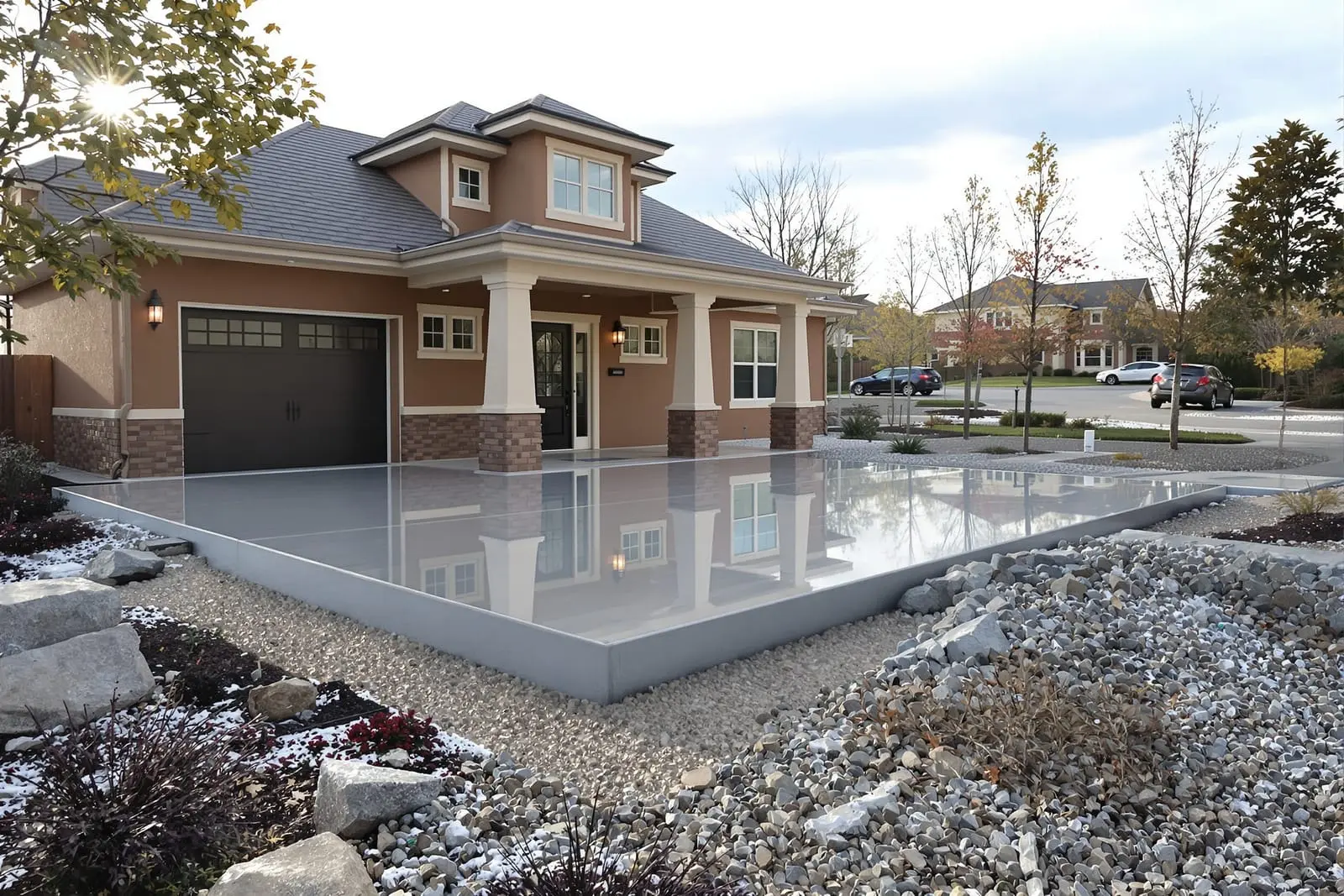
Outfit your site with durable commercial concrete flatwork in Phoenix, AZ. We pour slabs, walkways, dumpster pads, and service areas for businesses and facilities. Our team manages layout, grading, and finishing on projects of various sizes to keep your property functional and professional.
Vanguard Concrete Phoenix provides professional commercial concrete flatwork throughout Phoenix, AZ and the surrounding area. Our licensed, insured crew delivers safe, clean, on-time work with a free estimate before anything begins. Call (602) 560-6905 or request your free quote.
Commercial Concrete Flatwork Built for Phoenix Businesses
If your project depends on level, durable concrete, you are in the right place. Vanguard Concrete Phoenix specializes in commercial slabs and flatwork for properties across the Valley, from small infill lots to large industrial sites. We focus on getting the details right so you end up with concrete that actually performs in Phoenix heat, not just looks good on day one.
Commercial concrete flatwork covers everything from warehouse slabs and retail floors to parking lots, dumpster pads, walkways, loading docks, and equipment pads. Each of these sees different types of traffic and abuse. Our team designs thickness, reinforcement, and joint layouts around what your slab will really see: pallet jacks, forklifts, delivery trucks, carts, foot traffic, or a mix of all of them.
Phoenix is tough on concrete. Intense sun, rapid surface drying, and big temperature swings between afternoon and midnight can cause curling, random cracking, and dusting if the slab is not designed and placed for this climate. That is why Vanguard Concrete Phoenix uses proven local mix designs, proper curing methods, and saw cut timing tuned to desert conditions so your flatwork holds up for the long term.
Our Process for Reliable Commercial Slabs & Flatwork
Every project starts with a site visit. We look at access for ready mix trucks and pumps, existing grades, drainage paths during monsoon storms, and any nearby structures or utilities. We also talk through how the space will be used. For example, a refrigerated warehouse slab, a restaurant patio, and a trash enclosure pad all have different demands.
After that, we coordinate any needed soil testing or work with your geotechnical report if you already have one. Many Phoenix sites have expansive or loose soils that are not ready for a structural slab. Based on the report, we may recommend over excavation, importing engineered fill, moisture conditioning, and compaction to a specified percentage. We proof roll the subgrade so soft spots are corrected before concrete ever shows up.
Once the subgrade meets spec, we add base material if required, set elevations with laser levels, and build forms that match your plans or layout. For interior slabs or higher load areas, we place vapor barriers, dowels, and reinforcement such as rebar or welded wire mesh. On high performance slab projects we often use deformed rebar or dowel baskets at joints to reduce differential movement.
On pour day, we manage delivery timing and placement to avoid cold joints and inconsistent finishes. We use mechanical screeds and straightedges to hit flatness and levelness that match the use of the slab, then float, trowel, and finish according to the chosen texture. Finally, we install control joints at the right spacing and depth and apply curing methods that fit the weather conditions at that moment.
Design Options: Thickness, Reinforcement, and Finishes
Good commercial concrete flatwork is customized, not one size fits all. Vanguard Concrete Phoenix helps you pick the right slab thickness based on traffic and subgrade. Light duty walkways and patios might range from 4 to 5 inches, while trash enclosures, drive lanes, and loading areas often move to 6 inches or more with heavier reinforcement. For forklift aisles or equipment pads, we may design even thicker sections or add thickened edges.
Reinforcement choices depend on cracking control needs and budget. Basic slabs often use welded wire mesh, but for higher load or tighter crack control we use #4 or #5 rebar on a set grid, tied and chaired so it stays in the middle of the slab. On some large interior floors, we can use fiber reinforced mixes to reduce micro cracking and curling, often combined with traditional steel in high stress zones.
Finish options also matter in commercial settings. For parking lots and walkways, a broom finish provides slip resistance when we get those sudden monsoon downpours. Interior spaces might call for a hard troweled finish or a polished concrete system later. Patio and entry areas can use salt finishes, exposed aggregate, or integral color to complement your building. If you expect chemical exposure, like in auto shops or food prep areas, we help you plan for sealers or coatings that bond properly to the concrete profile we create.
We also pay close attention to slopes and drainage. Even a beautiful slab becomes a liability if water ponds near doors or along walkways. Our crews use laser levels and experienced finishers to build in subtle fall to drains or gutters so water moves where it should without creating trip hazards.
Costs, Local Codes, and Phoenix Specific Considerations
The cost of commercial concrete flatwork in Phoenix depends on several real factors: slab thickness, reinforcement type, surface finish, access for trucks and equipment, required subgrade work, and scheduling constraints. Simple, open parking lots with good access are less expensive per square foot than tight courtyard slabs that need pumping and hand work. Likewise, a 6 inch reinforced dumpster pad with heavily compacted base will cost more than a basic light duty walkway, but it will also survive years of trash truck traffic.
Local codes also affect design. Within Phoenix city limits and nearby municipalities like Tempe, Glendale, and Mesa, exterior flatwork that ties into public sidewalks or drive entrances often needs to match city standards for thickness, rebar, and slopes. For new builds or expansions, inspectors may check compaction test reports, reinforcement placement, and joint layouts before and after the pour. Vanguard Concrete Phoenix works with local building departments regularly and can coordinate needed inspections so you are not guessing about what is required.
Monsoon season timing is another Phoenix specific issue. Afternoon storms can damage fresh slabs if they are not protected. We schedule pours earlier in the day when possible during July and August, monitor radar, and have plastic and curing blankets on site to protect the surface if a surprise storm rolls in. In the cooler months, early morning temperatures may require adjustments to mix design and curing practices so the slab gains strength properly.
We also talk openly about long term maintenance costs. A well designed and properly jointed slab may have visible cracks, but they are controlled and non structural. We explain what is normal and what is not, how often to reseal exterior flatwork, and what to watch for in heavy traffic areas so minor joint spalling or surface wear can be handled before it becomes a larger repair.
What to Know Before Hiring a Commercial Concrete Contractor
Before you sign with any contractor, make sure they have experience with the specific type of commercial concrete flatwork you need. A crew that mostly does small residential patios will approach a 20,000 square foot warehouse floor very differently than a commercial specialist. Ask to see recent local projects similar in size and use to yours, and ask how they handled joint layouts, curling, and flatness requirements.
Vanguard Concrete Phoenix encourages you to ask detailed questions. Who lays out the joints and thickness transitions, the engineer or the contractor, and how will those be marked in the field. What is the plan if concrete trucks are delayed in summer heat. How will they verify compaction of the subgrade and base. Will there be a pre pour walk with you or your superintendent to confirm elevations, drains, and door thresholds.
You should also confirm that the contractor is familiar with city of Phoenix or your specific jurisdiction requirements for flatwork, including approaches, sidewalks, and ADA access routes. Even if you already have stamped plans, many issues are field decisions. A local contractor that understands how inspectors in this area interpret the code can save you time and rework.
Finally, look at the proposal itself. A solid commercial bid will spell out slab thickness, reinforcement type and spacing, base depth and material, finish type, joint spacing and method, curing approach, and any testing that is included. If something is vague, ask for details in writing. That clarity up front is what leads to a slab that performs the way you expect over its full life.
“
Professional commercial slabs & flatwork, done right the first time, quality materials, honest pricing, and results that last.
Vanguard Concrete Phoenix
Commercial Slabs & Flatwork Across Our Service Area