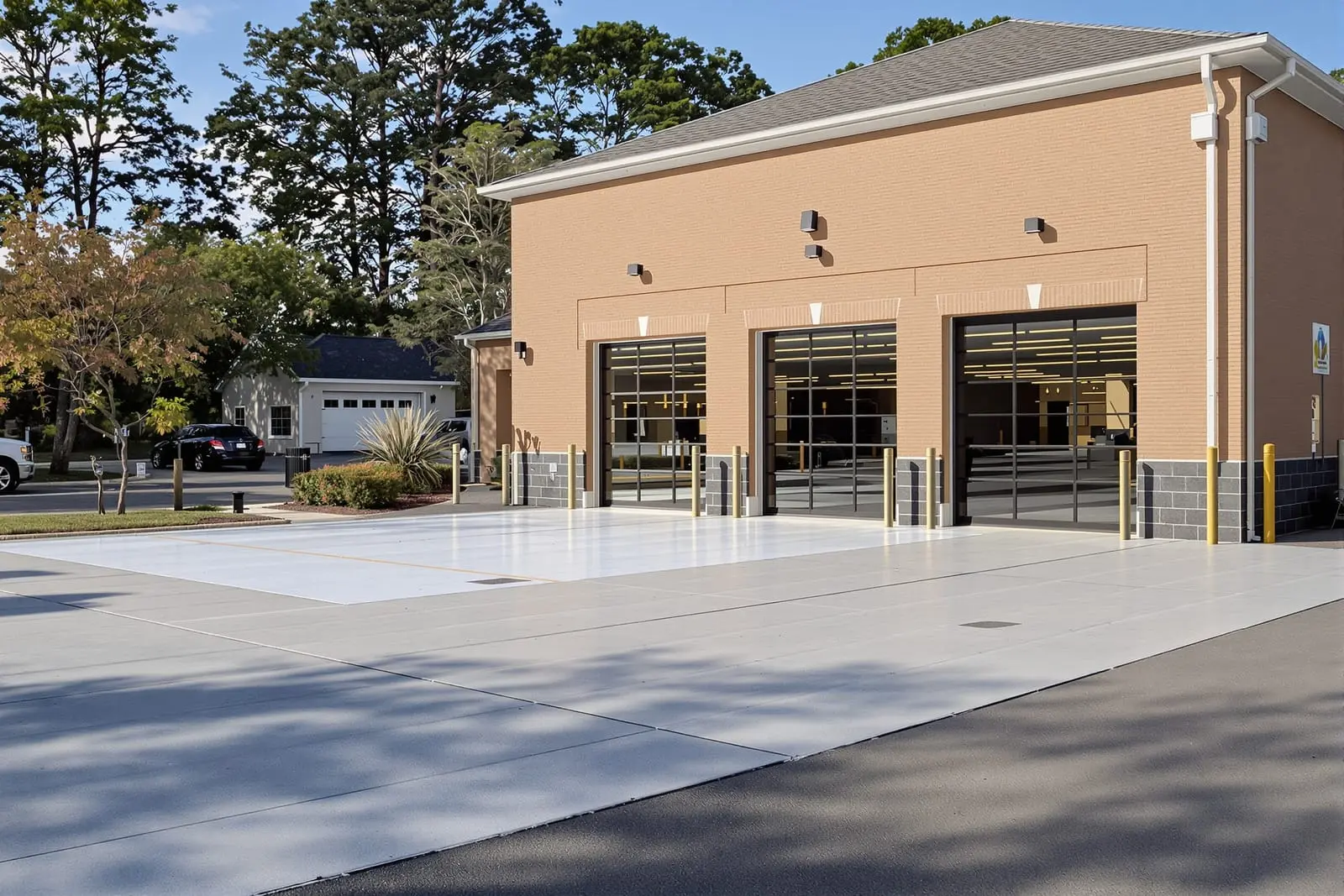
Support heavy traffic and equipment with a commercial concrete slab in Phoenix, AZ. We pour loading docks, dumpster pads, and equipment foundations designed for impact and point loads. Our team reinforces and thickens slabs where needed to handle service vehicles. Request a quote for new or replacement commercial slabs.
Vanguard Concrete Phoenix provides professional commercial concrete slab throughout Phoenix, AZ and the surrounding area. Our licensed, insured crew delivers safe, clean, on-time work with a free estimate before anything begins. Call (602) 560-6905 or request your free quote.
Commercial Concrete Slabs Built for Phoenix Conditions
Vanguard Concrete Phoenix designs and installs commercial concrete slabs and loading docks that are engineered for Phoenix heat, heavy vehicle traffic, and long operating hours. We focus on structural performance first, then on smooth workflow for your trucks, forklifts, and foot traffic.
Every project starts with how your site is actually used. We look at truck types and weights, turning movements, rack layouts, dock heights, and whether you use pallet jacks, narrow‑aisle forklifts, or high‑capacity lift trucks. From there we size slab thickness, joint spacing, and reinforcement to keep your floors flat and your loading docks safe and efficient.
Our team is familiar with local Phoenix soils, from compacted native caliche to imported ABC. That local knowledge matters. A correctly engineered commercial concrete slab on a poor subgrade will still crack and settle. We treat the slab and subbase as one system so your loading area does not deteriorate under the combination of heat, weight, and occasional monsoon runoff.
Planning and Design of Loading Docks and Slab Layouts
A reliable loading dock starts with correct geometry. Vanguard Concrete Phoenix works from truck manufacturer data and your existing building elevations to set the right dock height, dock bumper projection, and approach slope. We coordinate with dock leveler and overhead door suppliers so concrete dimensions match their equipment exactly.
On commercial concrete slab projects we map out column lines, racking, equipment pads, trench drains, and future expansion zones. Joint locations are laid out to avoid high traffic wheel paths and to stay clear of column bases and anchor bolts. For food, cold storage, or manufacturing clients, we adjust slab detailing for washdown, floor coatings, and temperature swings.
We also consider drainage at the outset. Many Phoenix facilities struggle with ponding water during monsoon storms. We design slopes and trench drains so water moves away from dock doors and pedestrian paths, and we detail concrete around inlets so they do not settle and create trip hazards.
Concrete Mixes, Thickness, and Reinforcement Choices
Commercial concrete slab performance in Phoenix is highly dependent on mix design and slab thickness. Vanguard Concrete Phoenix typically uses 4,000 to 5,000 psi concrete with low water‑cement ratios to reduce shrinkage. For exterior loading docks that sit in direct sun we specify air entrainment and proper curing to handle temperature swings and surface wear.
Slab thickness is determined by load. Light commercial interiors with pallet jacks might use a 5 inch slab on a compacted base. Heavy forklift traffic, high‑bay warehousing, or truck staging areas usually require 6 to 8 inch slabs, and in some heavy industrial cases we go thicker. We run load calculations rather than guess, so the slab is neither underbuilt nor more expensive than it needs to be.
For reinforcement we use rebar, welded wire fabric, or dowel baskets depending on the application. Exterior truck aprons and dock approaches typically get rebar grids and doweled contraction joints to keep panels aligned as temperatures change. Interior slabs that need tighter surface tolerances may use a combination of steel reinforcement and slab‑on‑grade design techniques that limit curling and random cracking.
How We Build Commercial Concrete Slabs and Loading Docks
Our field process is structured to avoid the common failures we see on older Phoenix slabs. Sitework begins with stripping organic material and proof‑rolling the subgrade. Any soft areas are excavated and replaced with compacted aggregate base. We document compaction with density tests where required by the engineer or city.
Forming comes next. For loading docks, we form dock faces, stair treads, curbs, and wheel stops to exact dimensions that match your dock equipment and trailer heights. On large interior slabs we use laser levels and string lines to control elevation across wide areas.
During placement, we use laser screeds or straightedges sized for the slab width to achieve uniform thickness. For loading docks and truck aprons we pay particular attention to reinforcing steel cover at the surface, which protects rebar from corrosion in exterior environments. Finishing is matched to use: broom finishes where tire traction is critical, light trowel for general warehouse traffic, or higher tolerance finishes where racking systems demand flatter floors.
Curing is critical in our climate. Phoenix heat can cause surface cracking within hours if curing is ignored. We use curing compounds, water curing, or a combination, and we schedule pours to avoid the hottest part of the day when practical. Proper curing dramatically improves surface durability and reduces dusting and early wear.
Common Problems We Prevent and How We Fix Existing Issues
In Phoenix, the most common loading dock and commercial concrete slab issues are slab settlement at dock doors, spalled joint edges under forklift traffic, random cracking from poor joint layout, and surface scaling from inadequate curing. Vanguard Concrete Phoenix designs and builds with these issues in mind so they are far less likely to occur.
We reduce settlement by insisting on correct subgrade preparation and by isolating slab edges around dock pits and building foundations. To protect joints, we use dowels, proper sawcut timing, and quality joint fillers where high‑frequency forklift traffic crosses the panels.
If you already have problems, we offer repair strategies tailored to your operation. Trip hazards at dock transitions can be corrected with partial‑depth repairs or concrete grinding. Heavily damaged slabs may require panel replacement with upgraded reinforcement and base preparation. We stage repairs to keep at least part of your dock or warehouse operational so you can continue receiving and shipping during the work.
Cost Drivers and Budgeting for a Commercial Concrete Slab
Commercial concrete slab and loading dock pricing in Phoenix depends on more than just square footage. The main cost drivers are slab thickness, reinforcement type, subbase preparation, access for concrete trucks and equipment, and any special finishes or coatings.
A basic interior slab in an open warehouse with good access will be more economical than a heavily reinforced dock apron that requires excavation, retaining walls, steps, and integration with existing buildings. If the site has poor soils that need over‑excavation and replacement, costs will increase but long‑term performance will improve.
Vanguard Concrete Phoenix provides clear line‑item estimates so you can understand where your budget is going. When needed, we propose alternates such as adjusting slab thickness in low‑load zones, changing reinforcement layouts, or phasing the work so your business can spread costs over time without compromising structural integrity.
What Phoenix Property Owners Should Know Before Hiring
Before you hire any contractor for a commercial concrete slab or loading dock in Phoenix, verify that they understand local codes, industrial loading requirements, and our climate. Ask for details on slab thickness, reinforcement, joint spacing, and curing methods. If a contractor cannot explain these in plain language, the slab may not perform over the long term.
It is also important to coordinate concrete work with your other trades. Dock equipment vendors, racking installers, electricians running floor boxes or dock lights, and plumbers installing trench drains must be on the same page. Vanguard Concrete Phoenix regularly coordinates pre‑pour meetings on commercial projects so embeds, sleeves, and anchor locations are set before concrete is placed.
Finally, ask about warranty and post‑pour support. Even a properly designed commercial concrete slab will develop hairline cracks, but there is a big difference between normal shrinkage and structural problems. We walk clients through what to expect, what to monitor, and when to call us so small issues are addressed early and your loading docks and slabs stay safe and functional for years.
“
Professional loading docks & commercial slabs, done right the first time, quality materials, honest pricing, and results that last.
Vanguard Concrete Phoenix
Loading Docks & Commercial Slabs Across Our Service Area